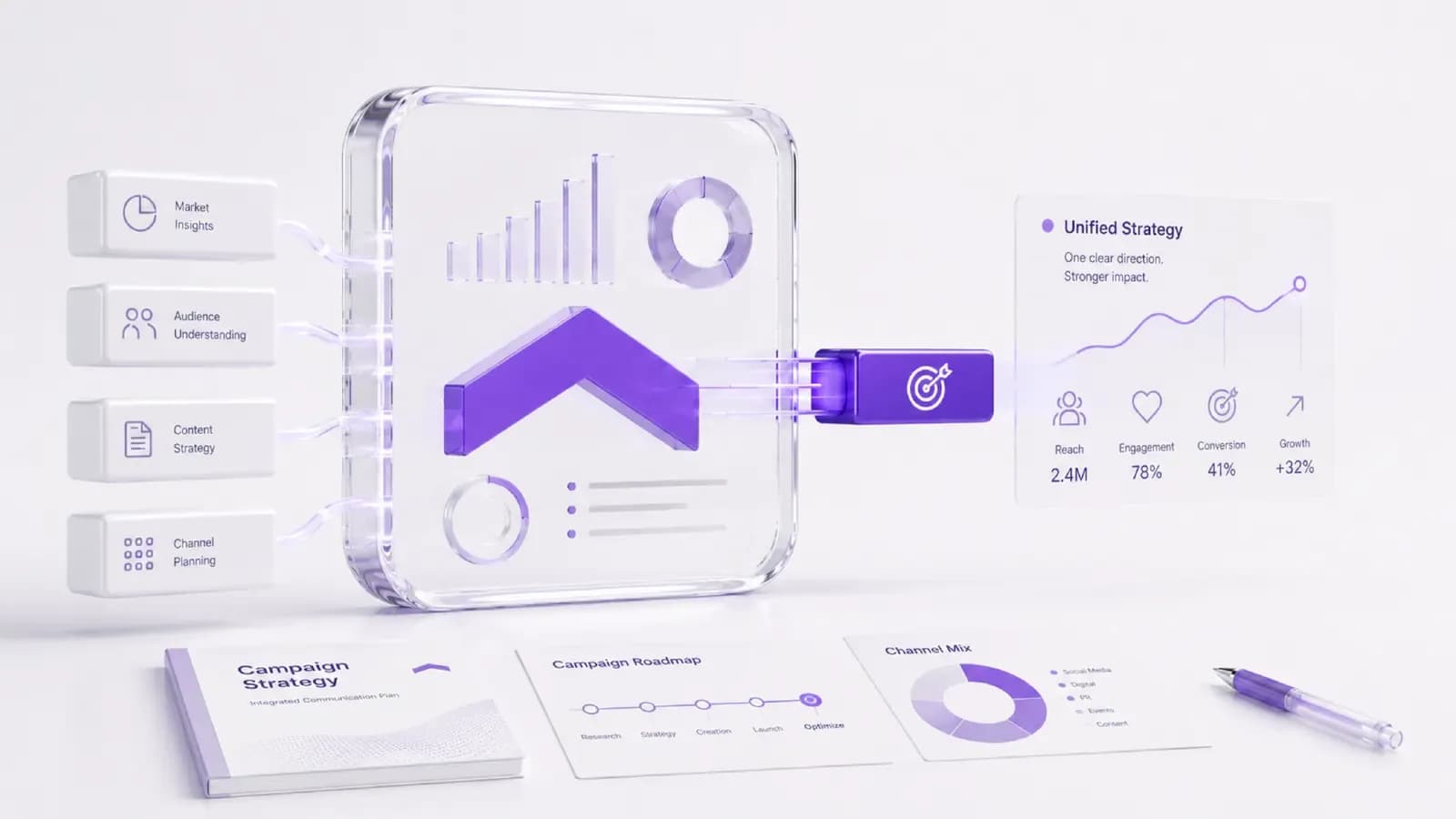
A step-by-step walkthrough of planning a 360 campaign, from a brief that earns good work to phasing, launch and a wrap report that makes the next campaign smarter.
Most organisations say they want a 360 campaign. Far fewer can say exactly what it should achieve, which channel carries which job, and how they will know it worked. A 360-degree marketing campaign is not a media list with every box ticked. It is one idea, built on one insight, working across the channels where the audience actually makes its decision.
This guide walks through how to plan a 360 campaign from the first brief to the post-campaign report: writing a brief that earns good work, setting objectives and KPIs, finding the insight and the idea, phasing the channel plan, running production and approvals, launching cleanly, optimising in flight and capturing what you learned. Along the way, we follow a hypothetical university admissions campaign so that each step has something concrete attached to it.
It is written for marketing directors, communications leads and the teams around them, in ministries, banks, retailers, universities and NGOs, who need a campaign to move a number rather than fill a calendar.
What a 360 campaign is really for
The term has been stretched so far that it often means little more than "a big campaign". The useful definition is narrower: a campaign in which strategy, creative, content and media are planned together, so that every touchpoint does a specific job in moving people from not knowing to acting. Those touchpoints can include television, outdoor, social, search, CRM, PR, events, on-ground activation and the website itself.
The test is not how many channels you use. It is whether the channels add up. If you could remove one channel and nothing in the audience journey would break, it probably did not need to be there, and its budget could work harder somewhere else.
A few signs separate a genuine 360 campaign from a merely busy one:
- One central idea that can be recognised in a six-second video, a billboard and a call-centre script.
- Every channel has a stated role, such as reach, consideration, conversion or retention, and a metric that matches that role.
- Messages build in sequence instead of repeating the same line everywhere.
- The owned channels, including the website, landing pages, call centre, branches and sales team, are ready for the demand that the paid channels create.
- Measurement is agreed before launch, not reverse-engineered after it.
The last two points are where most campaigns quietly lose value. A beautiful film that sends people to a slow landing page or an unprepared sales team has not failed at creative. It has failed at integration.
Start with a brief that earns the work
Everything downstream depends on the brief. A weak brief produces one of two outcomes: generic work that could belong to any brand, or round after round of revisions in which the brief is really being written through feedback.
A strong brief is short, specific and honest. It should fit on two pages. If it needs ten, the thinking has not been done yet.
What a strong campaign brief includes
- The business problem. Not "raise awareness", but the real commercial or institutional situation: enrolment for a new programme is behind plan, a new card is entering a crowded market, or citizens are not using a digital service that already exists.
- The single objective. One primary outcome the campaign is accountable for, with secondary outcomes listed separately so they do not compete for the same budget.
- The audience. Who they are, what they currently believe and do, and what we want them to believe and do afterwards. Include the people who influence the decision: parents, spouses, managers or procurement committees.
- What we already know. Existing research, past campaign results, sales and CRM data, customer service logs and search behaviour.
- The proposition and reasons to believe. What we can truthfully promise, and the proof that stands behind it.
- Mandatories and constraints. Brand guidelines, regulatory requirements, approval bodies, languages and markets.
- Budget range, timing and key dates. Including the immovable ones: national days, Ramadan, school calendars and fiscal year-end.
- How success will be judged. The KPI and the target, or at least the agreed method for setting one.
Two habits make briefs noticeably better. First, write the brief together: the client team owns the business knowledge, and the campaign team owns the questions that sharpen it. Second, have it signed off by the person who will approve the final work. A brief approved by a middle manager and creative judged by a chief executive is a reliable recipe for late surprises.
If the business problem itself is unclear, and nobody can agree whether the issue is awareness, perception or the product, that is a signal to step back before briefing a campaign at all. Diagnosing the problem before prescribing the campaign is the job of marketing communications strategy.
Set objectives and KPIs before you talk about ideas
Objectives come in layers. The business objective is what the organisation needs. The communication objective is what the audience needs to know, feel or do. Channel objectives are what each touchpoint contributes. Mixing the layers up is how teams end up judging a reach channel on conversions, or a search campaign on brand recall.
For each layer, choose one or two KPIs, decide where the data will come from, and agree a baseline. Without a baseline there is no story at the end.
| Layer | Example objective | KPI | Data source |
|---|---|---|---|
| Business | Fill the first intake of a new programme | Completed applications; enrolments | Admissions system or CRM |
| Communication | Make the programme known and credible among students and parents | Awareness; consideration; message recall | Pre- and post-campaign brand tracking |
| Reach channels | Get the idea seen by the right people | Reach and frequency in the target audience; video completion | Media platforms and ad servers |
| Consideration channels | Turn interest into exploration | Landing page visits; time on programme pages; brochure downloads | Web analytics |
| Conversion channels | Turn exploration into action | Enquiries; cost per qualified lead; application starts | Analytics and CRM |
| Retention and advocacy | Keep applicants engaged until they enrol | Open day attendance; drop-off between application and enrolment | CRM and event registrations |
Notice the word "qualified" in cost per qualified lead. Cheap leads that the sales or admissions team cannot convert are not a win; they are a cost that has simply moved downstream. Agree with the receiving team what a qualified lead means, in writing, before launch.
Finally, set targets honestly. Use past campaigns, benchmarks you trust and the projected reach of the media plan to model what is achievable. A target that nobody believes does not motivate anyone. It simply guarantees that the wrap report becomes an exercise in explanation rather than learning.
From insight to an idea that travels
An insight is not a fact about the audience. "Students compare universities online" is a fact. An insight is a tension or truth that explains behaviour and opens a door for the brand: "Students choose the programme, but parents choose the university, and the two are asking very different questions."
Good insights rarely come from a single source. They come from triangulating what people say, what they do and what the front line sees every day. In the Sudace Framework, this is the movement from Discover through Analyze to Understand: mapping the environment, turning data and observation into insight, then naming the opportunity and the communication gap.
Some of the most productive sources are close to home:
- Conversations with front-line staff: sales teams, call-centre agents, admissions officers and branch staff.
- Search queries and the questions people type, which often reveal anxieties more honestly than surveys do.
- Social listening, including the comment sections on your own content and on competitors' content.
- Small, focused qualitative sessions with the real audience, including the people who influence the decision.
- Your own CRM: where people drop out of the journey, and what the ones who convert have in common.
The creative idea is the bridge between the insight and the channels. Test it with a simple question: can it be expressed in a single sentence, and can you picture it as a film, a billboard, a social series, a PR story and an event? If the idea only works as a film, it is an advertisement, not a campaign platform.
Write the idea up as a short platform document: the line, the tone of voice, the visual system and how it flexes by channel and language. In this region, flexing by language is not translation. An Arabic headline that carries the idea natively will usually outperform a perfect translation of an English one, and sometimes the idea should be born in Arabic first and adapted into English.
Channel plan and phasing for a 360-degree marketing campaign
Once the idea exists, the channel plan decides where it lives and when. Start from the audience journey, not from the media menu. Map the moments when people are open to the message: when they first start thinking about the decision, when they compare options, when they are ready to act and after they have acted.
Then give every channel a job. Television, outdoor and online video build reach and fame. Social and content build understanding and conversation. Search captures the demand that the rest of the plan creates. CRM, messaging and the front line convert and retain. PR and events add credibility that paid media cannot buy on its own.
Most 360 campaigns run in three phases: teaser, launch and sustain. Not every campaign needs a teaser; a promotional retail campaign often goes straight to launch. But the logic of building, peaking and sustaining applies almost everywhere.
| Phase | Purpose | Typical channels | What to measure | Common mistake |
|---|---|---|---|---|
| Teaser | Create curiosity, prime the audience, seed PR and creators | Social teasers, outdoor reveals, creator seeding, press previews, owned-channel countdowns | Reach, engagement, growth in branded search | Being so cryptic that the teaser is never connected to the brand |
| Launch | Peak reach, land the core message, drive the first action | Hero film, TV or connected TV, high-impact outdoor, social and video at scale, PR, launch event, search | Reach and frequency, video completion, site traffic, first conversions | Spreading the budget so thin that nothing reaches effective frequency |
| Sustain | Convert interest, answer objections, stay present | Performance social, search, retargeting, CRM and WhatsApp journeys, content series, on-ground activation | Cost per qualified lead, conversion rate, drop-off points | Running the launch creative until it wears out instead of moving to proof |
| Post-campaign | Retain, nurture and learn | CRM, community content, PR on outcomes, partner channels | Retention, advocacy, learnings captured | Switching everything off the day the budget ends |
Durations depend on the audience's decision cycle. A teaser might last a week or two; a sustain phase for a considered purchase or an admissions season can run for many weeks, while a short retail promotion may compress all three phases into a fortnight.
The sustain phase is where many campaigns are won or lost. Launch creative states the idea; sustain creative does the persuading, through testimonials, product proof, FAQs, comparison content and deadline reminders. Plan it in the brief, not as an afterthought once the launch assets start to fatigue.
Budget allocation should follow the phases. One useful discipline is to hold back a reserve: unallocated budget kept for the channels that prove themselves in the first weeks. It turns optimisation from a conversation into an action.
Production, approvals and the launch checklist
Production planning
A 360 campaign multiplies assets quickly. One idea becomes a film with cut-downs, outdoor in several sizes, social formats, display banners, a landing page, CRM messages, PR materials and scripts for front-line staff, usually in two languages. Build an asset matrix early: every asset, format, language, channel, owner and deadline, in one shared document that everyone works from.
Shoot for the whole campaign, not just the film. If the production day only captures the hero spot, the social and sustain phases end up with recycled frames and stock imagery. Plan vertical framing, behind-the-scenes footage, portrait photography and short-form content on the same shoot. This is why the content team should sit in pre-production rather than receive files afterwards, and why joined-up content and social media planning saves real money at this stage.
Approvals without the bottleneck
Approvals are where timelines go to die. Agree at the start who approves what, at which stage, how many rounds are allowed and how long each round takes. Then separate the stages: approve the idea, then the scripts and key visuals, then the finished assets. Revisiting the idea at the finished-asset stage is the most expensive change a campaign can make.
In government and regulated sectors such as banking, healthcare and education, build legal and regulatory review into the plan as a fixed stage with its own time allocation.
The launch checklist
About a week before launch, walk through a checklist with everyone involved. A missing tracking tag or an unbriefed call centre can cost more than a weak headline ever will.
- Tracking: analytics, pixels and conversion events tested end to end; a UTM structure agreed and applied to every link.
- Landing pages: live, fast on mobile, available in both languages, with forms tested and submissions arriving where they should.
- Media: campaigns built, audiences checked, budgets and flight dates confirmed, frequency caps set.
- Assets: final files trafficked in every format and language, with no placeholder copy and all legal lines in place.
- Front line: call centre, sales, branches or admissions briefed on the message, the offer and the likely questions.
- Community management: response guidelines and an escalation path ready for comments and messages, including sensitive ones.
- PR: press materials ready, spokespeople briefed, embargo times set.
- Reporting: a dashboard live with baselines, and a reporting cadence with named owners.
- Contingency: a plan for the obvious risks, such as a delayed approval, a platform rejecting an ad, or a news event that makes the timing inappropriate.
Optimising a 360 campaign in flight
Launch day is the start of the experiment, not the end of the plan. The first days of real data will challenge at least some of your assumptions about audiences, formats and messages.
Set a rhythm: daily checks on spend and delivery in the first week, weekly performance reviews after that, and a fuller mid-campaign review where the bigger decisions are made. Agree in advance which changes the campaign team can make on its own and which need client sign-off, so that good decisions are not delayed by a meeting.
The main levers are usually these:
- Budget between channels and phases, drawing on the reserve.
- Audiences: narrowing, expanding, excluding people who have already converted, and building lookalikes from qualified leads.
- Creative rotation: retiring fatigued assets, scaling the winners and testing new hooks on the same idea.
- Messaging: shifting from the launch message to objection-handling as real questions surface in comments and calls.
- The landing experience: form length, page speed and the order in which information appears.
Watch the signals that do not sit in ad dashboards. What are people asking the call centre? Which questions keep appearing in the comments? Are walk-in visitors mentioning the campaign? These qualitative signals often explain the numbers before the numbers explain themselves.
Resist over-optimising on the cheapest metric. If you move everything into the channel with the lowest cost per click, you may starve the reach channels that create the demand those clicks are harvesting. Judge every channel against the role it was given in the plan.
The wrap report: turning a campaign into learning
The wrap report is where a campaign earns its value a second time, by making the next one better. Too many wrap reports are decks of screenshots and large impression numbers.
A useful wrap report answers five questions:
- Did we achieve the business objective, measured against the baseline and target agreed in the brief?
- What did each channel contribute, judged on the role it was given?
- What worked creatively, and what did the audience actually respond to?
- What went wrong or slower than planned, in planning, production, approvals or execution?
- What will we do differently next time, expressed as specific actions with owners?
Be candid about attribution. Multi-channel campaigns do not break down neatly into last-click credit. Combine platform data, web analytics, CRM outcomes and brand tracking, and state clearly where the picture remains uncertain.
Hold the wrap session with both teams and, ideally, with people from the front line. Then store the learnings somewhere the next campaign team will actually find them. This is the Amplify stage of the Sudace Framework: measuring, learning and feeding insight into what comes next, so that each campaign starts smarter than the one before.
A worked example: a university admissions campaign
To see how the pieces connect, imagine a private university in Riyadh launching a new undergraduate programme in a high-demand field, alongside its regular admissions season. The application window is fixed by the academic calendar, so every date in the plan works backwards from the deadline.
Brief and objectives
The business problem is clear: the university is respected for its established programmes, but the new one has no track record, and prospective students are weighing it against established alternatives at home and abroad. The primary objective is to fill the first intake with qualified applicants. The secondary objective is to strengthen the university's reputation for forward-looking education. The brief names two audiences, students and parents, and agrees with the admissions office what counts as a qualified enquiry.
Insight and idea
Conversations with admissions staff and a handful of focus groups reveal the tension. Students are excited by the field; parents worry that a brand-new programme is a risk for their child's future. The campaign idea answers both sides: the first cohort are framed as pioneers, while a parallel stream of proof reassures parents through faculty profiles, industry partnerships, facilities and a clear explanation of the programme's quality assurance.
Phasing
The teaser runs for two weeks before admissions open: a social countdown, outdoor reveals near campuses and shopping centres, and faculty stories seeded with education creators. The launch brings the hero film for students, a parallel content series for parents, PR around the programme's industry partners, search and social at scale and an on-campus launch event. The sustain phase runs until the deadline with performance social and search, retargeting of page visitors, WhatsApp journeys from enquiry to open day, live question-and-answer sessions with faculty and deadline reminders.
In flight and the wrap
Mid-campaign, comments and calls show parents repeatedly asking about career outcomes. The team moves part of the reserve into a parent-focused series on career pathways and adds a careers section to the landing page. At the wrap, the report tracks applications against target, the drop-off between application and enrolment, the content that moved parents most, and one clear learning: parent-focused content should start at launch next year, not halfway through.
The same structure works for very different briefs. A summer retail campaign might use a new-collection reveal as its teaser, a promotion carried by outdoor and social at launch, and product content with retargeting through the season. You can see how integrated thinking plays out across sectors in our success stories.
Planning your next 360 campaign with Sudace
A strong 360 campaign is less about being everywhere and more about being coherent: one insight, one idea, every channel with a job, and learning built in from the first day. Sudace's integrated marketing communication team plans and runs campaigns this way across Saudi Arabia, Jordan and the wider region, from the first brief to the wrap report.
If you have a campaign on the horizon, talk to our team about the brief.
Frequently asked questions
What is a 360-degree marketing campaign?
It is a campaign in which strategy, creative, content and media are planned as one system around a single idea. Each channel, from outdoor and video to search, CRM and the sales team, is given a specific role in moving the audience from awareness to action. The number of channels matters less than how well they connect.
How long does it take to plan a 360 campaign?
It depends on the scale of production, the number of languages and markets, and how many approval layers are involved. A simple retail campaign can be planned in a few weeks, while a campaign with a film shoot and regulatory review needs considerably longer. Work backwards from the launch date and give approvals their own fixed time in the plan.
What are the phases of a 360 campaign?
Most campaigns follow a teaser, launch and sustain structure, followed by a post-campaign period for nurturing and learning. The teaser builds curiosity, the launch delivers peak reach and the core message, and the sustain phase does the persuading with proof, answers to objections and reminders. Short promotions sometimes skip the teaser.
How do you measure the success of a 360 campaign?
Set KPIs in layers before launch: a business outcome such as sales or applications, communication measures such as awareness and consideration, and channel metrics that match each channel's role. Agree a baseline for each, then combine platform data, web analytics, CRM results and brand tracking in the wrap report rather than relying on last-click attribution.

Sudace's strategy, insights and creative team in Riyadh and Amman. We write about marketing communications, campaigns, content and the audiences of Saudi Arabia, Jordan and the wider region.