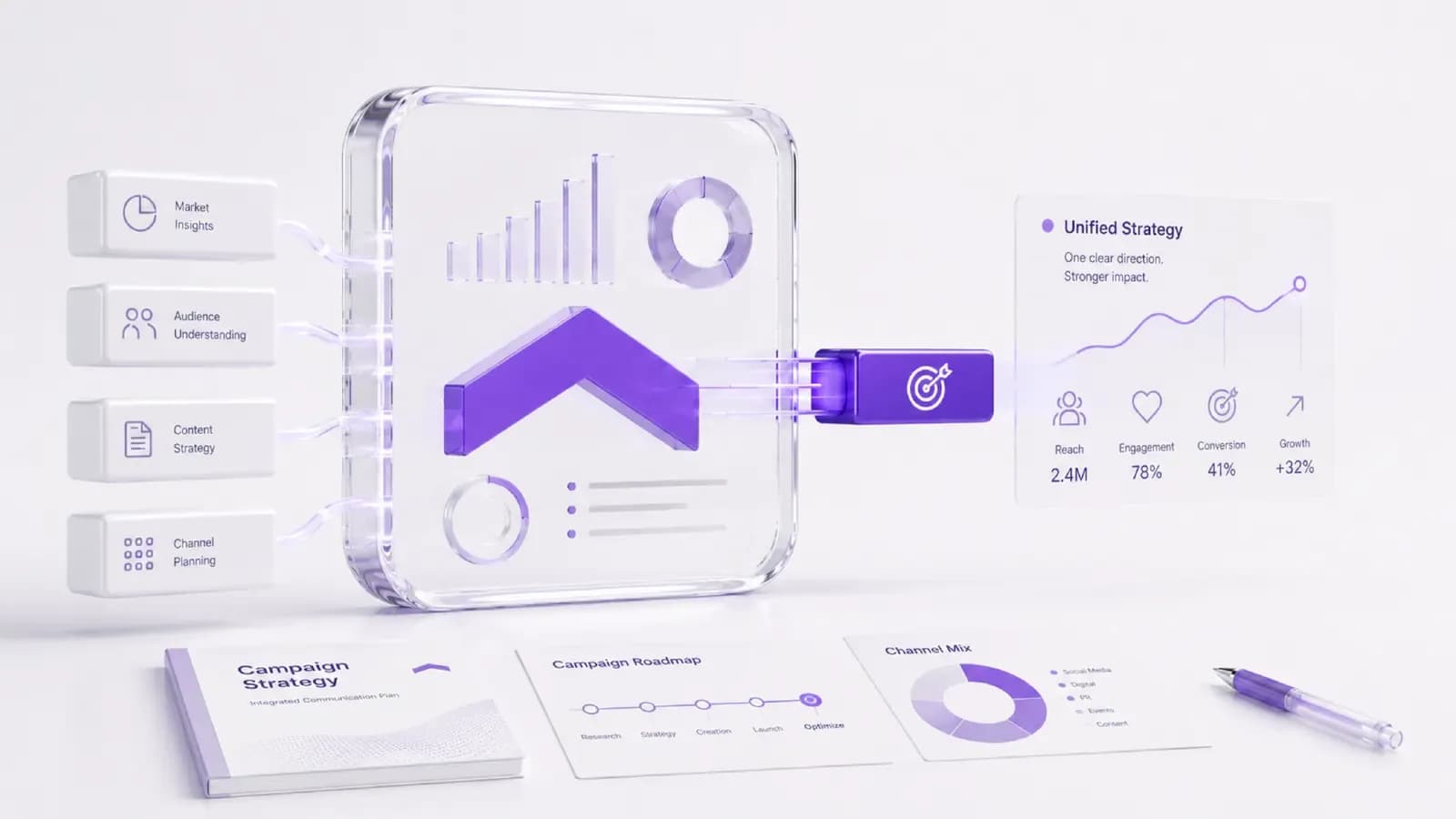
A grounded view of AI in marketing communications: where it speeds up research, content and media, where it falls short, and how teams can adopt it without losing their voice.
Few topics generate as much noise in boardrooms right now as AI in marketing communications. One camp expects it to replace agencies, writers and media planners within a few budget cycles. Another camp treats it as a passing fashion that produces bland copy and embarrassing mistakes. Both positions are easier to hold than the truth, which is more useful and less dramatic.
AI is very good at some parts of communications work and genuinely poor at others. It can compress hours of reading into minutes, produce fifty variations of a headline before lunch, and spot patterns in campaign data that a tired analyst would miss. It cannot decide what an organisation stands for, judge whether a message will land with a sceptical minister or a first-time customer in Jeddah, or carry responsibility when something goes wrong.
This article sets out a grounded view: what changes, what does not, where the risks sit, and how a communications team can start using these tools without losing control of its voice, its data or its reputation. It is written for leaders who have to make decisions about AI, not for those who want to be impressed by it.
What AI in marketing communications actually changes
The simplest way to think about AI in marketing communications is that it lowers the cost of producing a first draft of almost anything: a summary, a brief, a caption, a translation, an image concept, a media scenario. When the cost of a first draft falls close to zero, the scarce resource becomes judgement about which draft is right, and why.
That shift has three practical consequences. First, speed rises across research, production and reporting. Second, volume rises, because teams can create more versions for more audiences and channels. Third, the risk of mediocrity rises, because it becomes easy to publish a lot of content that is technically correct and strategically empty.
What does not change is the logic of good communications. An organisation still needs a clear understanding of its audiences, a sharp positioning, a narrative people can repeat, and a plan that connects messages to outcomes. AI makes each step faster. It does not make any step optional.
It helps to separate three kinds of work when assessing where AI fits:
- Mechanical work — formatting, resizing, transcribing, tagging, first-pass summaries. AI can take most of this on with light supervision.
- Craft work — copywriting, editing, design, scripting, translation. AI can assist and accelerate, but a skilled person must shape and approve the result.
- Judgement work — strategy, positioning, crisis decisions, stakeholder sensitivity, creative direction. AI can inform these decisions; it should not make them.
Most disappointment with AI comes from treating judgement work as if it were mechanical. Most missed opportunities come from treating mechanical work as if it still needs a senior person's afternoon.
Research and insight: faster listening, slower judgement
Research is where many teams feel the benefit first. Social listening tools already use machine learning to cluster conversations, detect sentiment and surface emerging topics. Language models add another layer: they can read a large set of open-ended survey responses, interview transcripts or customer complaints and produce a structured summary of recurring themes in a fraction of the time a person would need.
This is valuable in the early stages of a strategy, when the goal is to understand the environment quickly. A team can review what audiences say about a category, how competitors describe themselves, and which questions people keep asking, then decide where to dig deeper. In the Sudace Framework this sits squarely in Discover and Analyze: gathering the landscape and turning raw observations into early insights.
The caution is that a summary is not an insight. AI tends to report what is frequent, not what is important. A single comment from a regulator, a pattern of silence from a key segment, or an emotional undercurrent that nobody states directly may matter more than the top five themes in a dashboard. Sentiment scoring is also notoriously weak with sarcasm, mixed dialects and culturally specific humour, all of which are common in Arabic social conversation.
Good practice looks like this:
- Use AI to read widely and propose themes, then have an analyst read a sample of the original material to check that the themes are real.
- Ask the tool to show the evidence behind each theme, so claims can be traced back to actual posts, responses or documents.
- Treat any number the tool produces as a prompt for verification, not a finding to put in a board paper.
- Reserve the "so what" — what the theme means for positioning, messaging or risk — for people who understand the organisation and its stakeholders.
In short, AI widens the funnel of what a team can listen to. It does not replace the person who decides what is worth hearing.
Content production and versioning at scale
Content is where the change is most visible. A single campaign today might need a long-form article, a brand film script, cut-downs for several social platforms, display banners in multiple sizes, email copy, website updates and messaging for spokespeople, all in two languages. Producing every version by hand is slow and expensive, and inconsistencies creep in.
AI is well suited to the versioning layer of this work. Once a core idea, key messages and a tone have been agreed, tools can help adapt copy to different lengths and formats, suggest alternative headlines for testing, draft subtitles and transcripts, propose image directions, and resize or reframe visual assets. This frees creative teams to spend more time on the idea itself and less on mechanical adaptation.
The weak point is the idea. Language models are trained to produce plausible text, and plausible is the enemy of distinctive. Left to its own devices, AI will write the same safe sentence that thousands of other brands are also publishing. Organisations that let tools generate concepts end-to-end often find their content looks and sounds like everyone else's, which defeats the point of communications in the first place.
A practical division of labour is to keep the creative platform, the central narrative and hero content firmly human-led, then use AI to extend that platform across formats and channels. This is the approach we recommend for content and social media programmes where volume matters but the brand cannot afford to sound generic.
Three rules help keep quality high when content volume grows:
- Every AI-assisted piece has a named human owner who has read it in full before it goes out.
- Facts, figures, names, titles and claims are checked against a source the team controls, never taken from the model.
- Visual outputs are reviewed for cultural fit, accuracy of details such as dress, architecture and script, and rights to any likeness or reference used.
Personalisation and media optimisation
Personalisation has been promised for many years. AI makes a more modest version of it realistic: tailoring messages to clearly defined segments, adjusting creative by context, and learning which combinations of message, format and placement perform best. Advertising platforms already automate much of this through algorithmic bidding, audience expansion and dynamic creative assembly.
For media teams, this means less manual adjustment and more emphasis on the inputs that guide the machine. The quality of the creative variations, the clarity of the conversion signal, the structure of campaigns and the definition of success all shape what the algorithm learns. A poorly defined objective, fed into a powerful optimisation system, will be pursued very efficiently in the wrong direction.
There are also limits worth naming. Optimisation systems favour what is easy to measure, such as clicks and short-term conversions, over what is harder to measure, such as trust, consideration and long-term brand preference. Hyper-targeting can fragment a message until no shared story remains. And personalisation that feels too precise can unsettle audiences rather than engage them, particularly in markets where privacy expectations are rising.
The answer is to treat AI optimisation as one part of an integrated campaign, not a substitute for it. Strategy sets the objective and the narrative; creative provides strong, distinct variations; media and AI tools then find the most efficient path to the right people; and measurement checks whether brand outcomes, not only platform metrics, are moving.
The Arabic-language challenge
For organisations in Saudi Arabia, Jordan and the wider region, language quality is not a detail. It is often the deciding factor in whether AI is usable at all for public-facing work. Most large models have been trained on far more English than Arabic, and it shows.
Common issues include Arabic text that reads like a translation from English, with English sentence structures and idioms carried over; awkward or incorrect gender and number agreement; inconsistent terminology across a single document; and a flat register that is neither elegant Modern Standard Arabic nor natural colloquial speech. Dialect is a further challenge. Content that works for a Saudi audience may sound out of place in Amman, and vice versa, and models rarely handle that difference reliably.
Visual generation adds its own risks. Image tools frequently render Arabic script incorrectly, with disconnected letters or reversed text, and can produce scenes, clothing or settings that do not reflect the region accurately. For government and institutional clients in particular, these errors are not cosmetic; they undermine credibility.
Teams working in Arabic should plan for this explicitly:
- Write the Arabic version natively for priority content, rather than generating it from English and hoping for the best.
- Build an Arabic glossary of approved terms, titles, product names and preferred phrasings, and include it in every prompt or brief.
- Have a senior Arabic editor review all AI-assisted Arabic copy, with authority to rewrite rather than just correct.
- Decide per channel which register and dialect is appropriate, and document that decision so tools and people apply it consistently.
- Never publish AI-generated imagery containing Arabic script without checking every letter.
AI can still speed up Arabic work considerably, especially for drafting, summarising and adapting. But the standard has to be set by people who write Arabic well, not by what the tool happens to produce.
Brand voice, governance and accountability
Every organisation that uses AI in communications will eventually face the same question: who is responsible when something goes wrong? An inaccurate claim in a press release, a culturally insensitive image, a leaked confidential document pasted into a public tool, an off-brand response from a chatbot. The answer must always be a person, and the governance model should make it clear which person.
Brand voice is the first area to protect. If dozens of people across an organisation use AI tools without shared guidance, the result is not one voice but many slightly different ones, all drifting towards the generic. A brand voice guide written for AI use — with examples of what the brand sounds like and what it never sounds like, in both languages — helps keep outputs consistent.
The table below is a useful starting point for dividing responsibility between tools and people.
| Area | AI helps with | Humans stay accountable for |
|---|---|---|
| Research | Summarising large volumes of data, clustering themes, monitoring conversations | Deciding which insights matter, validating evidence, interpreting context |
| Strategy | Generating options, stress-testing arguments, drafting frameworks | Positioning, priorities, trade-offs and the final strategic choice |
| Creative | Variations, adaptations, mood references, first drafts | The core idea, creative direction, taste and cultural fit |
| Arabic content | Drafting, summarising, terminology suggestions | Register, dialect, accuracy, elegance and final approval |
| Media | Bidding, budget pacing, audience expansion, creative rotation | Objectives, success definitions, brand safety and budget decisions |
| Reporting | Pulling data, drafting summaries, flagging anomalies | Explaining what happened, why, and what to change next |
| Risk and reputation | Early warning on spikes in conversation or sentiment | Crisis decisions, statements, and stakeholder engagement |
Governance does not have to be heavy. For most teams it means an approved list of tools, clear rules on what data can be used with them, a defined review step for each type of output, and a simple log of where AI was used in significant pieces of work.
Ethics, disclosure, privacy and accuracy
Responsible use of AI in marketing communications rests on four commitments. Each one is simple to state and requires discipline to apply.
Accuracy
Language models can produce confident statements that are false, including invented statistics, fictional quotes and non-existent sources. In communications, where credibility is the main asset, this is the most immediate risk. The rule is straightforward: no fact enters published material unless a person has verified it against a reliable source the organisation can stand behind.
Disclosure
Audiences increasingly want to know when they are interacting with a machine or viewing synthetic media. Platform policies and regulations in many markets are moving in the same direction. A sensible default is to disclose when content is substantially AI-generated in ways that could affect how people interpret it — for example, synthetic people in an advertisement, an automated assistant answering questions, or a realistic image of an event that did not happen.
Privacy and confidentiality
Pasting customer data, unpublished financial results, government briefings or personal information into a public AI tool can expose an organisation to legal and reputational harm. Saudi Arabia and Jordan both have data protection frameworks that organisations must respect, and many sectors carry additional obligations. Teams need clear rules on which tools are approved for which kinds of information, and enterprise settings that prevent data from being used to train external models.
Fairness and representation
AI systems reflect the data they were trained on, including its biases. Generated images may default to narrow stereotypes; targeting systems may exclude groups unintentionally. Reviewing outputs for representation, and auditing who campaigns actually reach, should be part of the normal quality process rather than an afterthought.
How to start using AI in marketing communications
The teams that get value from AI rarely begin with a grand transformation programme. They begin with a few well-chosen use cases, clear rules and honest measurement. A practical path has four steps.
1. Select use cases deliberately
List the tasks your team repeats most often and score each one on three questions: how much time does it consume, how much harm could an error cause, and how easy is it to check the output? The best starting points are high-time, low-harm, easy-to-check tasks such as summarising research, drafting social variations of approved messages, transcribing interviews or preparing first drafts of reports. Leave high-stakes outputs — crisis statements, executive speeches, regulatory communications — until the team has experience and controls in place.
2. Write short, usable guidelines
A two-page document that people actually read is worth more than a long policy nobody opens. It should cover approved tools, data rules, disclosure standards, review requirements by output type, Arabic quality standards and who to ask when unsure. Include examples of good and bad use, because principles alone are easy to misinterpret.
3. Run time-boxed pilots
Choose two or three use cases and run each as a pilot for a fixed period with a small group. Define in advance what success looks like: time saved, quality maintained or improved, error rate, team confidence. Compare against how the same work was done before. Be willing to stop a pilot that is not working; that is a result, not a failure.
4. Build review into the workflow
Review should not depend on individual goodwill. Build it into the workflow so that AI-assisted outputs pass through the same approval steps as any other material, with an additional check for the specific risks AI introduces: factual accuracy, Arabic quality, brand voice and rights. Over time, the review step becomes faster as people learn where tools tend to fail.
Alongside these steps, invest in people. The skill that matters most is not prompt writing in isolation; it is the ability to brief clearly, evaluate critically and edit decisively. Those are communications skills, and the best AI users on most teams turn out to be the best editors.
A hypothetical example: launching a savings product
Consider a hypothetical retail bank in the region preparing to launch a new savings product aimed at young professionals, with campaigns in Arabic and English across social media, digital display, its app and its branches.
In the discovery phase, the team uses AI tools to summarise public conversation about saving, financial pressure and banking among young adults, along with competitor messaging and the bank's own customer feedback. The tools surface recurring themes: frustration with complicated terms, interest in goal-based saving, and scepticism about promotional rates. An analyst reads a sample of the source material, confirms two themes, discards one that turns out to be driven by a single viral post, and adds an observation the tools missed: many young customers talk about saving for family obligations rather than personal goals.
That observation shapes the strategy. The positioning centres on saving as a way of taking care of the people who matter, not only personal ambition. The narrative, key messages and creative platform are developed by the strategy and creative teams, with AI used to test alternative phrasings and challenge weak arguments, but not to decide the direction.
In production, the core film script and hero visuals are human-written and human-directed. AI then helps generate cut-downs for each platform, headline variations for testing, app notification copy and branch display text. The Arabic copy is written natively by an Arabic copywriter for the hero assets; AI-assisted Arabic variations are reviewed and partly rewritten by a senior editor, who also corrects a recurring error in how the product name is rendered.
During the campaign, platform algorithms optimise delivery across the agreed creative variations, while the media team watches not only cost per sign-up but also brand search and sentiment. AI drafts weekly performance summaries; the account lead edits them into a clear account of what is working, what is not and what the team will change. When a misleading post about the product's terms gains traction, the listening tools flag the spike early, but the response is written, approved and issued by people.
The result in this scenario is not a campaign "made by AI". It is a campaign made faster, tested more widely and reported more clearly, with people firmly in charge of every decision that affects the brand.
Where Sudace fits
At Sudace we treat AI as part of being future-focused, not as a replacement for insight, strategy or craft. We help organisations decide where these tools belong in their communications, set the guidelines and review processes that protect their voice in both languages, and build them into campaigns that still start from a clear understanding of audiences. That work sits at the heart of our marketing communications strategy practice.
If your team is weighing how to adopt AI responsibly, or wants a second view on a plan already in motion, talk to us in Riyadh or Amman.
Frequently asked questions
Will AI replace marketing communications teams?
No. AI takes on much of the mechanical work and speeds up drafting, but positioning, creative direction, stakeholder judgement and accountability still sit with people. Teams change shape rather than disappear, with more weight on briefing, editing and decision-making.
Is AI reliable for writing Arabic marketing content?
It is useful for drafts, summaries and adaptations, but quality varies widely. Common issues are translated-sounding phrasing, agreement errors, inconsistent terms and the wrong register or dialect. Priority Arabic content should be written natively and every AI-assisted text reviewed by a senior Arabic editor.
Should brands disclose when content is made with AI?
A sensible default is to disclose whenever AI use could change how people interpret the content, such as synthetic people in an advert, an automated assistant, or a realistic image of something that never happened. Platform rules in many markets are moving the same way, so a clear internal standard saves debate later.
What is the best first use case for AI in a communications team?
Start with tasks that take a lot of time, carry low risk if something goes wrong and are easy to check, such as summarising research, transcribing interviews or adapting approved messages for different formats. Run them as short pilots with clear success measures before moving to higher-stakes work.

Sudace's strategy, insights and creative team in Riyadh and Amman. We write about marketing communications, campaigns, content and the audiences of Saudi Arabia, Jordan and the wider region.