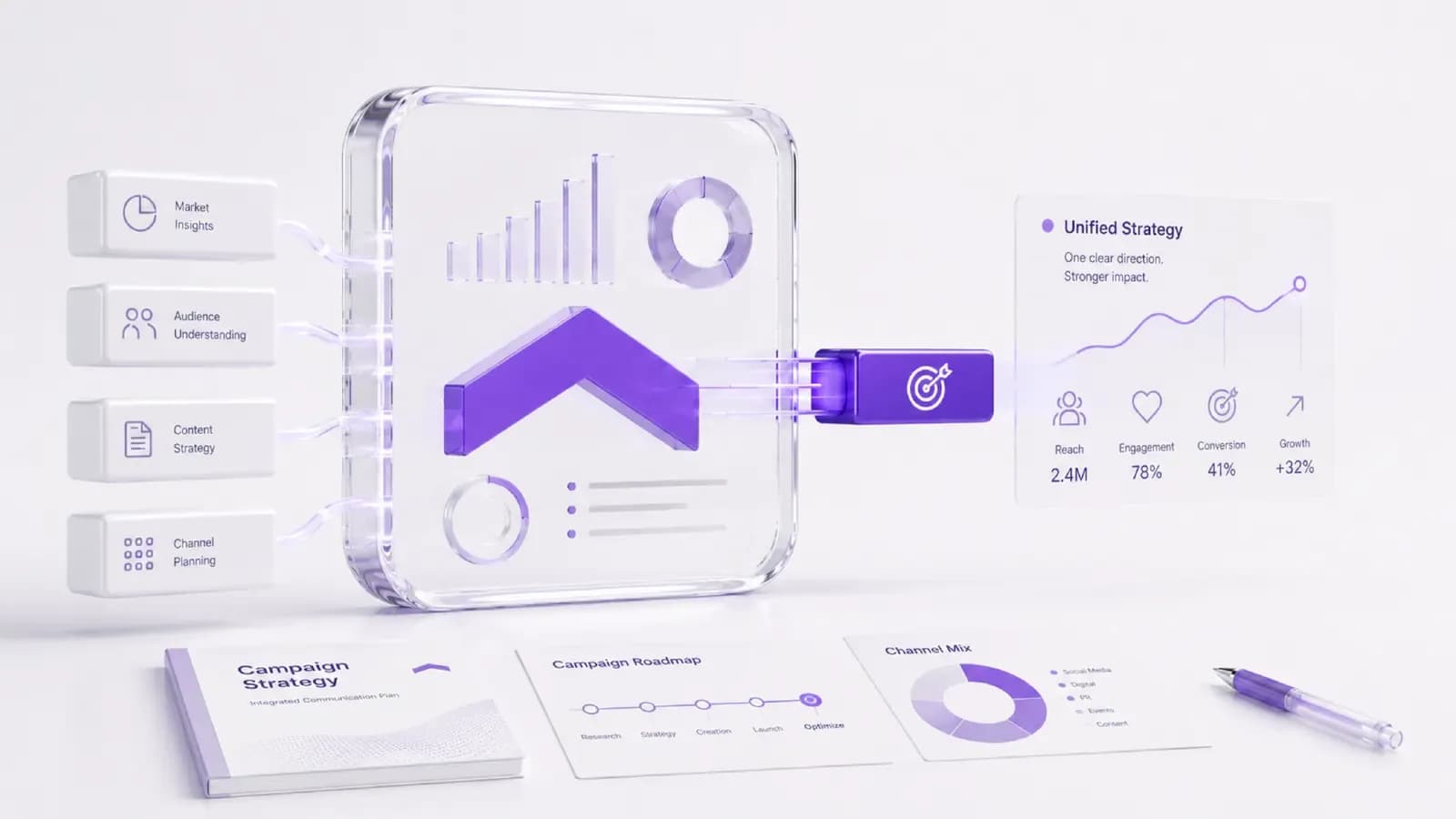
What integrated marketing communications really means, why one idea across every channel beats disconnected activity, and how to organise, govern and measure it.
Most organisations already communicate through many channels. They run social media, buy media, issue press releases, host events, send newsletters and brief their staff. The problem is rarely a lack of activity. The problem is that each activity is planned by a different team, briefed at a different time and judged by a different number, so the audience receives a dozen loosely related messages instead of one clear story. Integrated marketing communications is the discipline that fixes this.
Done properly, integrated marketing communications (IMC) turns scattered output into a single, coordinated system. One idea travels across every touchpoint, each channel does the job it is best at, and the whole programme is measured against shared outcomes rather than channel vanity metrics. The result is not just a tidier calendar. It is communication that people actually remember and act on.
This guide covers what integration means in practice, its building blocks, how to organise and govern it, how to measure it, a worked example and the failure points we see most often.
What integrated marketing communications really means
Integrated marketing communications is often reduced to "consistent branding": same logo, same colours, same tagline everywhere. Visual consistency matters, but it is the least of it. A campaign can look identical on every screen and still be badly integrated if the messages contradict each other, the channels compete for the same job and nobody owns the overall result.
A more useful definition is this: IMC is the practice of planning all communication around a single strategic idea and a single understanding of the audience, then assigning each channel a specific role in moving that audience from awareness to action. It is a way of thinking before it is a way of producing.
Three things distinguish a genuinely integrated programme from a coordinated-looking one:
- Shared strategy. Every team works from the same objective, the same audience insight and the same core message, written down in one place.
- Designed roles. Channels are chosen and briefed for what they contribute to the journey, not simply because they were used last year.
- Common measurement. Success is defined at programme level first, and channel metrics are read in the light of that, not in isolation.
Integration also extends beyond marketing. Customer service, sales conversations, the website and leadership speeches all say something about the organisation. If they pull in different directions, the campaign has to work twice as hard.
Why one message outperforms disconnected activity
Audiences do not experience channels; they experience a brand. A person might see an outdoor board on the drive to work, a short video at lunch and a news story in the evening. They do not file these under "OOH", "social" and "PR". They either recognise a single story building in their mind, or they register noise.
When every touchpoint reinforces the same idea, each exposure adds to the last. Recognition comes faster, the message is easier to recall, and the organisation looks confident and well run. When touchpoints conflict, each one partly cancels the others. The budget is spent, but the memory never forms.
Integration also produces practical gains inside the organisation:
- Efficiency. One big idea can be adapted rather than reinvented for every channel, so creative and production resources go further.
- Speed. When the strategy and message architecture are agreed up front, teams can produce and approve content faster because the basic questions are already answered.
- Resilience. If one channel underperforms or a media opportunity disappears, the programme still holds together because the other channels carry the same story.
- Credibility. Stakeholders such as regulators, partners, investors and employees see a coherent organisation, which matters greatly for governments, financial institutions and large corporates.
In markets such as Saudi Arabia and Jordan, where audiences move fluidly between television, social platforms, messaging apps and physical spaces in a single day, this coherence is especially valuable. A fragmented approach struggles to follow them; an integrated one meets them with the same idea wherever they are.
The building blocks of an IMC programme
Every strong integrated programme is built from the same components. The proportions change with the objective and budget, but leaving one out tends to show.
1. One big idea
The big idea is the organising thought that every piece of communication expresses. It is not a slogan, although it may produce one. It is a simple, ownable truth about what the organisation offers and why it matters to the audience, framed in a way that can live in a 6-second video, a press interview, an event stage and an employee briefing alike.
A good test: can three different teams, given only the big idea, produce work that clearly belongs together? If the answer is no, the idea is either too vague or too tied to a single execution. This idea should come out of a clear marketing communications strategy, not out of a creative brainstorm held in isolation.
2. The audience journey
Integration depends on understanding how people actually move from not knowing you to choosing you. Map the journey in stages that reflect real behaviour: becoming aware, getting interested, considering options, deciding, using and recommending. For each stage, note what the audience needs to know or feel, what questions they ask and where they spend their attention.
Different audiences may need different journeys. A government programme might speak to citizens, businesses and media at once. Map each priority audience separately, then look for the points where their journeys overlap.
3. Channel roles
Once the journey is clear, each channel gets a defined job. Television and large-format outdoor might create broad awareness and emotional resonance. Search captures active intent. Social builds conversation and keeps the idea alive between bursts. PR earns credibility. The website and customer service convert interest into action. Writing these roles down prevents the common situation in which every channel is asked to do everything and none does anything particularly well.
4. Paid, owned and earned media
A balanced programme uses all three types of media deliberately. Paid media buys reach and control over timing. Owned media, such as the website, app, social accounts, newsletters and physical spaces, gives you a permanent home for the story and the data that comes with it. Earned media, meaning press coverage, organic sharing, reviews and partner endorsements, provides third-party credibility that paid media cannot buy.
The strongest programmes design paid activity to drive people to owned platforms and create moments worth earning attention for. Each type amplifies the others.
5. Public relations
PR is not a press release sent out after the advertising is finished. In an integrated programme, PR shapes the story from the start: finding the news angle, preparing spokespeople and anticipating difficult questions. It gives the big idea substance by showing evidence behind the claim.
6. Digital and social
Digital channels are where most audiences spend time and where most interaction happens. They are also where integration is easiest to break, because content volume is high and many hands touch it. Social content, influencer partnerships, search, display and email should all carry the same idea while respecting each platform's native style. A well-structured content and social media plan translates the big idea into a steady rhythm of platform-specific stories rather than one asset resized everywhere.
7. Events and experiences
Launch events, exhibitions, roadshows and sponsorships give people a physical encounter with the idea, and they generate content, press interest and conversation. Design the event as part of the campaign narrative, with content capture, media invitations and follow-up planned in advance, not as a standalone occasion.
8. Internal communications
Employees are often the first audience and the most overlooked. If frontline staff, branch teams or call centre agents hear about a campaign from an advert, the experience they deliver will not match the promise. Brief internal teams before launch, give them the core messages and answers to likely questions, and invite them to become ambassadors. Internal communication is where the external promise is either kept or broken.
Channel roles at a glance
The table below shows how a typical integrated programme might assign roles across channels. The specifics will vary, but the principle holds: every channel has a primary job, a stage of the journey it serves best and a measure that reflects that job.
| Channel | Primary role | Journey stage | What to measure |
|---|---|---|---|
| Television and online video | Introduce the big idea with emotion and scale | Awareness | Reach, ad recall, completion rate |
| Outdoor and large format | Build familiarity and local presence | Awareness | Coverage by location, brand recall |
| Public relations | Add credibility and news value | Awareness, interest | Quality and tone of coverage, message pickup |
| Social media (organic) | Sustain conversation, show personality | Interest, loyalty | Engagement quality, shares, sentiment |
| Social and display (paid) | Extend reach, retarget interested audiences | Interest, consideration | Cost per qualified visit, view-through |
| Influencers and partners | Lend trusted voices to the story | Interest, consideration | Audience fit, saves, referral traffic |
| Search | Capture active intent | Consideration, decision | Branded search volume, conversion rate |
| Website and app | Explain, reassure and convert | Consideration, decision | Conversion, drop-off points, time to action |
| Events and activations | Create direct experience and content | Interest, decision | Attendance quality, leads, content generated |
| Email and CRM | Nurture, onboard and retain | Decision, loyalty | Open and click quality, retention, repeat action |
| Internal communications | Align staff to deliver the promise | All stages | Staff awareness, readiness, feedback |
No single channel owns the final outcome; it is the combined effect, which is why measurement must be designed at programme level.
How to organise teams and agencies around integration
Integration fails more often because of structure than creativity. If the social team, media buyer, PR adviser and events producer each receive different briefs from different people, the work will fragment no matter how good the idea is.
Appoint a single owner
Every integrated programme needs one accountable lead, in-house or on the agency side, who owns the strategy, the message architecture and the overall results. They need not approve every post, but they decide when work drifts off-strategy and arbitrate between channels competing for budget.
Write one master brief
Start with a single master brief that states the business objective, the communication objective, the priority audiences, the core insight, the big idea, the message hierarchy, the mandatory brand elements and the success measures. Channel briefs are then derived from it, not written from scratch. If a channel brief contradicts the master brief, the master brief wins.
Run a shared rhythm
Integration needs regular contact. A practical rhythm looks like this:
- Kick-off workshop with every team and partner in the same room to agree the strategy and roles.
- Weekly integration meeting during production and live phases to review the shared calendar, upcoming content and any issues.
- Shared calendar visible to all teams, showing launches, media bursts, PR moments, events and key content.
- Monthly performance review looking at programme-level results first, then channel results, with decisions on reallocation.
- Post-campaign review that captures what worked together, what did not and what to carry into the next cycle.
Choose an agency model deliberately
Organisations usually choose between a single lead partner, a lead partner orchestrating specialists, or an in-house team coordinating specialists directly. Each can work. What does not work is a roster of specialists with no one joining them up. If you use several partners, make the orchestration role explicit in contracts and measure every specialist partly on shared outcomes.
Governance and brand consistency
As programmes scale, more people produce content and more markets get involved. Governance stops the idea from eroding: light enough not to slow teams down, firm enough that the core never shifts by accident.
A practical governance toolkit includes:
- A message house. One page that sets out the big idea at the top, three or four supporting messages beneath it and the proof points for each. Every piece of content should trace back to it.
- Brand and tone guidelines. Clear rules on visual identity and voice, with examples of what is and is not on-brand, in both Arabic and English where relevant.
- Bilingual standards. In Arabic and English markets, decide early whether content is adapted or created natively in each language. Direct translation rarely carries the same meaning or emotion, so give each language its own writer working from the same message house.
- An approval matrix. Who approves what, within what time. Routine social posts should not need the same sign-off chain as a national television spot.
- A risk and response protocol. Agreed steps for handling negative comments, misinformation or a crisis, so that every channel responds consistently and quickly.
Consistency does not mean uniformity. A message can be playful on one platform and formal in a ministerial speech and still be the same message. The test: would someone exposed to both recognise the same organisation saying the same thing?
Measuring integrated marketing communications
Measuring integrated marketing communications is harder than measuring a single channel, because the value is in the combination. Channel dashboards will always tell you that their channel did well. The task is to build a measurement framework that looks at the whole system first.
Set objectives at three levels
Start with the business objective, such as applications, registrations, sales or service adoption. Beneath it, set communication objectives such as awareness, understanding, preference or trust among specific audiences. Beneath those, set channel objectives that describe what each channel must contribute. Each level should be measurable, and the links between levels should be logical.
Use a balanced set of indicators
Combine indicators that show reach, engagement, perception and action:
- Reach and frequency across channels, de-duplicated where possible, to understand how many people saw the idea and how often.
- Brand and message metrics such as prompted and unprompted recall, message association and sentiment, ideally tracked before, during and after the campaign.
- Behavioural signals such as branded search, direct website visits, enquiries and social mentions, which often rise when integration is working.
- Business outcomes such as conversions, sign-ups or service usage, linked as closely as possible to campaign periods and audiences.
Look for integration effects
The clearest sign that integration is working is that channels perform better together than apart. Compare results in periods or regions where several channels ran together against those where only one or two ran. Watch whether search and direct traffic rise after broadcast bursts, whether PR coverage lifts social engagement, and whether retargeted audiences convert better after seeing upper-funnel content. Controlled tests, holdout regions and before-and-after tracking all help build this picture over time.
Measure consistency itself
It is also worth auditing the work. Sample content from every channel each month and score it against the message house: does it express the big idea, does it carry the right supporting message, does it follow the brand and tone rules? A simple consistency score makes drift visible before it becomes a problem.
A worked example: a bank launches a new card
To make this concrete, consider a hypothetical scenario. A regional bank is launching a new rewards card aimed at young professionals. Its business objective is card applications over a three-month launch period. Its communication objective is to make the card known and understood as the simplest way for this audience to get real value from everyday spending.
The insight. Research and social listening suggest that young professionals feel most reward programmes are complicated and that points rarely turn into anything useful. They want benefits they can actually feel.
The big idea. "Rewards you notice." Every piece of communication shows a specific, tangible moment when the card gives something back, rather than abstract points or percentages.
Channel roles. The plan assigns jobs as follows:
- Online video and outdoor introduce the idea through short stories of everyday moments in recognisable local settings, building awareness in the first four weeks.
- PR positions the launch as a response to what young customers say they want, with the bank's leadership explaining the thinking and the product team available for interviews.
- Social media runs a series showing real-life reward moments, invites people to share what they would notice most and answers questions quickly in comments and direct messages.
- Creators who genuinely speak to young professionals show how the card fits into their routines, briefed with the message house but free to use their own voice.
- Search and paid social capture people who start comparing cards, sending them to a landing page that explains the benefits in plain language and allows applications in a few steps.
- A launch event in a popular venue gives media and creators a first-hand experience, generating content for the following weeks.
- Branch and call-centre teams are briefed a week before launch with the key messages, a short FAQ and a simple way to demonstrate the benefits.
- Email and in-app messages target existing customers in the right segment and onboard new cardholders with early reward moments to reinforce the promise.
Governance. A single campaign lead owns the master brief. A weekly integration meeting reviews the shared calendar. All Arabic and English copy is written natively from the same message house. A response protocol covers common complaints and fee questions.
Measurement. The bank tracks applications as the business outcome; awareness and message association among the target audience as communication outcomes; and reach, engagement quality, branded search, landing-page conversion and staff readiness as channel outcomes. It compares cities where outdoor and events ran with those where only digital ran, to understand how much the combination adds.
The point is not the specific channels. It is that every activity has a defined role, expresses the same idea and is judged against the same goal. You can see how this kind of thinking plays out in real campaigns in our success stories.
Where integration usually breaks
Even well-intentioned programmes fall apart in predictable places. Knowing them in advance makes them easier to avoid.
- Starting with channels instead of strategy. When the first question is "what should we post?" rather than "what do we need people to believe?", the result is activity without direction.
- A big idea that only works in one format. An idea built around a single television script often collapses on social or in PR. Test the idea across formats before committing.
- Too many messages. Trying to say everything at once dilutes the core. Prioritise ruthlessly and let supporting messages appear in the right places, not everywhere.
- No single owner. Without one accountable lead, every team optimises for its own metrics and the whole drifts apart.
- Separate budgets with separate targets. When each channel defends its own budget, money cannot move to where it works best. Hold some budget centrally for reallocation.
- Translation instead of adaptation. In bilingual markets, a literal translation can change the tone or miss the cultural point entirely. Each language needs its own native craft.
- Forgetting employees. If staff are not briefed, the customer experience contradicts the campaign at the moment it matters most.
- Measuring only what is easy. Clicks and impressions are simple to report but say little about whether the idea is landing. Invest in perception and outcome measures from the start.
Most of these failures share one root cause: integration treated as a production task rather than a strategic one. Fix the thinking and structure, and execution follows.
Building an integrated programme with Sudace
At Sudace, integration is how we work rather than an add-on. Our framework moves from Discover, Analyze and Understand into Strategize, then Activate and Amplify, so that insight shapes the big idea, the big idea shapes every channel and measurement keeps improving the programme over time. From Riyadh and Amman, we help governments, corporations, NGOs and brands plan and run integrated marketing communications in which strategy, creative, content and media work as one.
If you are planning a launch, a rebrand or a campaign that needs every channel pulling in the same direction, talk to our team about where to start.
Frequently asked questions
What is integrated marketing communications in simple terms?
It is planning every piece of communication, from advertising and PR to social media, events and staff briefings, around one strategic idea and one understanding of the audience. Each channel is given a specific job, and success is judged on shared outcomes rather than separate channel scores.
What is the difference between IMC and a 360-degree campaign?
A 360-degree campaign describes coverage: being present on many channels at once. IMC describes coordination: making sure those channels share one idea, play complementary roles and are measured together. A campaign can be on every channel and still be poorly integrated.
How do you measure whether integrated marketing communications is working?
Set objectives at business, communication and channel level, then track reach, brand and message recall, behavioural signals such as branded search, and business outcomes. The strongest evidence is when channels perform better together than apart, which you can test by comparing regions or periods with different channel mixes.
Do small organisations need integrated marketing communications?
Yes, arguably more than large ones, because they cannot afford to waste budget on messages that cancel each other out. Integration does not require many channels; it requires a clear idea, defined roles for the channels you do use and one person responsible for keeping them aligned.

Sudace's strategy, insights and creative team in Riyadh and Amman. We write about marketing communications, campaigns, content and the audiences of Saudi Arabia, Jordan and the wider region.